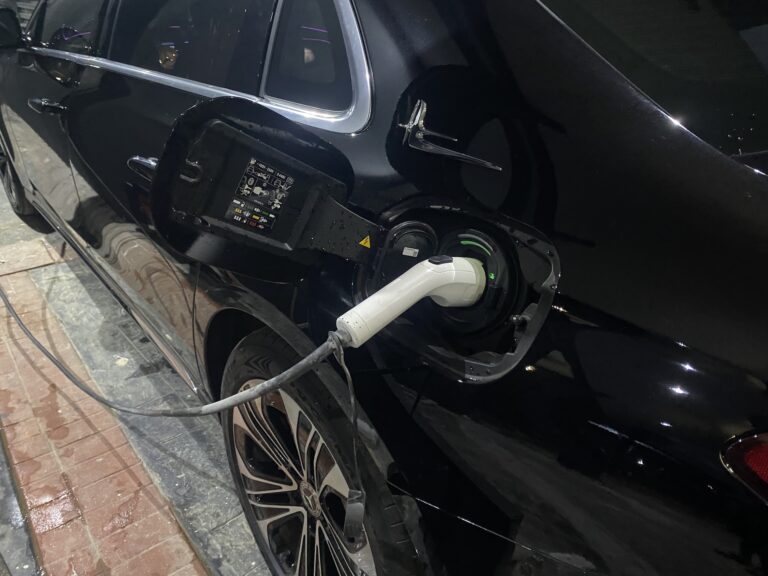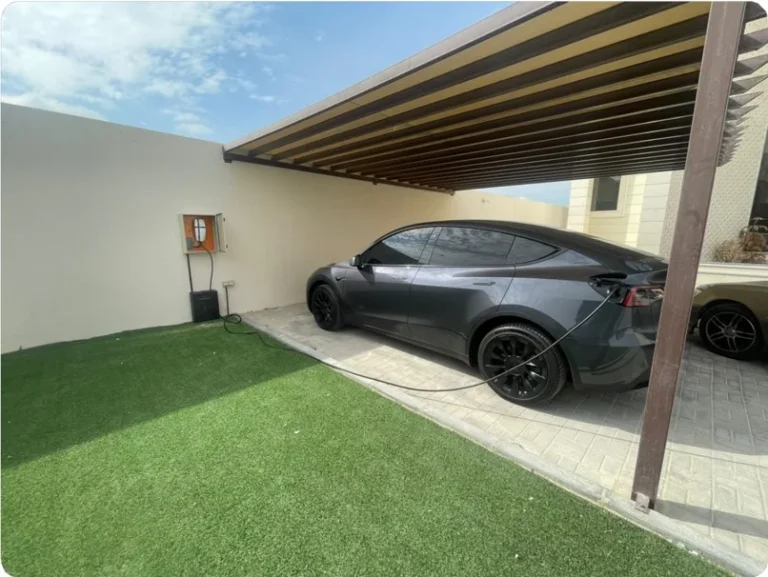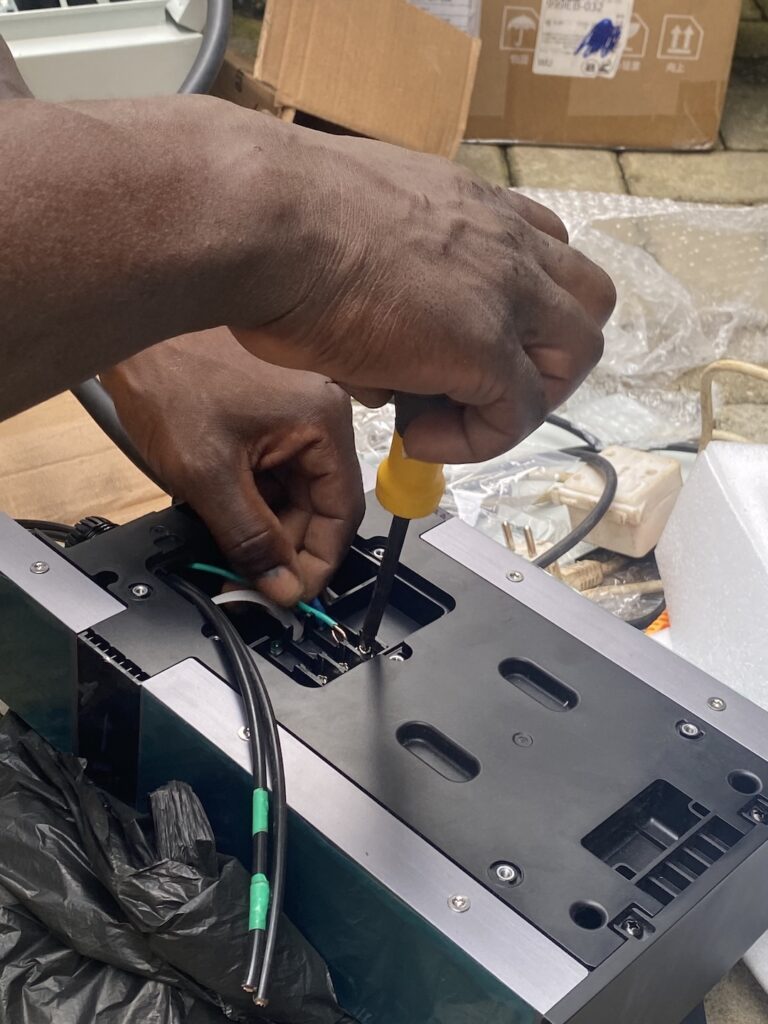
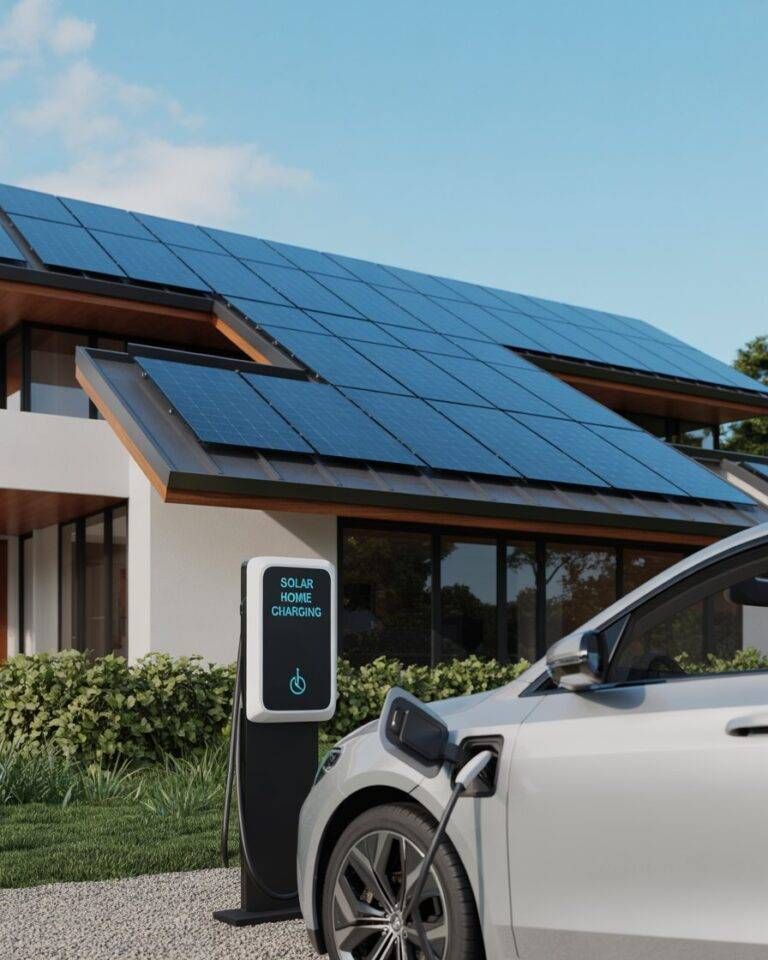
Almost every Abuja home that can afford an electric car already has solar panels, an inverter and a battery bank. That changes the charging question completely. You are not just asking how to power a charger. You are asking which of three sources should power it, and when.
The three sources, and what each is good for
- Grid supply: the cheapest energy per unit when it is available, and the only source that can comfortably sustain a 7.4kW draw for hours.
- Solar: free once installed, but only available in daylight and only in the quantity your array produces at that moment.
- Battery storage: stored energy you have already paid for, and the one you least want a car to drain.
The mistake is treating them as interchangeable. A car charging at 7.4kW will empty a domestic battery bank in a couple of hours, which is exactly the energy you were keeping for the house.
Why an EV charger is different from every other load
Most household appliances are intermittent. An EV charger is not: once it starts, it pulls its full rated current continuously until the battery is full. That constant draw is what overwhelms inverters sized for ordinary household use, and what trips main breakers when nobody has done a load assessment.
This is why the first step in any solar-integrated installation is arithmetic, not wiring: what your inverter can sustain, what your array produces at midday, what your battery holds, and what the house needs at the same time.
Charging from surplus solar
A solar-powered EV charging station at home is not one product you buy. It is an arrangement. The most satisfying version is one where the car charges from whatever the array is producing beyond what the house is using. A smart charger that can modulate its current makes this possible: as clouds pass and production dips, the charger reduces its draw rather than pulling the difference from your batteries.
For a deeper look at pairing solar with EV charging, see EV charging installation from Abuja Solar & Energy Company. Using a solar panel for EV charging works best if the car is home during the day: a second vehicle, a work-from-home household, or a weekend car. If your EV is out every day and back at eight in the evening, solar charging is not the answer for it, and there is no sense paying for the capability.
Protecting the battery bank
Whatever the arrangement, the charger should be configured so it will not run the batteries down. That can mean charging only when the grid is present, only above a set state of charge, or only within a set window. It is a configuration decision made at installation, and it is the difference between a system that helps and one that leaves you in the dark at midnight.
Scheduling and current limiting
- Schedule the charge for late night when household demand is lowest.
- Limit the current so the charger never uses the whole capacity of your supply.
- Set a target below full. Most daily driving needs far less than a complete charge.
- Stagger vehicles if you have two, rather than charging both at once.
These four settings solve most capacity problems without a single upgrade, and they cost nothing, and they usually cost less than upgrading the supply.
When you do need an upgrade
If the numbers genuinely do not work (a full board, an undersized main cable, an inverter at its limit), the honest answer is that part of the job is electrical upgrade rather than charger installation. We would rather tell you that up front than hang a charger on a supply that cannot carry it.
Getting it designed properly
Solar, inverter and EV charging can work together very well in Abuja, but only if someone does the sizing before anything is mounted on a wall. We handle the load assessment, the integration and the charger configuration as one job. See our EV charging services, or start with our home EV charger installation guide.
Have solar and want your EV to use it? Call (+234) 706 727 6002, message us on WhatsApp, or book a free site assessment.