The word that causes the most confusion for new EV owners is charge point. People use it to mean the box on the wall, the socket on the car, the cable, and the plug on the end of it, and those are four different things with four different standards. Getting them straight takes five minutes and saves you buying the wrong equipment.
The two halves of every charging session
There is AC charging and there is DC charging, and they are genuinely different processes.
- AC charging sends alternating current to the car, and the car’s own onboard charger converts it to DC for the battery. The onboard charger is the bottleneck, which is why a car might only accept 7.4kW even from a 22kW wallbox.
- DC charging does the conversion inside the charging unit and feeds the battery directly. That is why DC units are large, expensive and fast.
Home and workplace charge points are almost always AC. Public fast chargers are DC. This is the single most useful distinction to hold onto.
Level 1, Level 2 and Level 3: the American names
A lot of what you will read online uses American terminology, and it trips people up because it describes something different. Level describes how much power is delivered. Type describes the shape of the plug. They are not alternatives to each other.
- Level 1: charging from an ordinary domestic socket with the cable that came with the car. Extremely slow, and hard on a socket that was never designed for hours of continuous load. Fine as an emergency option, not as your daily arrangement.
- Level 2: a dedicated AC circuit feeding a wallbox. This is what almost every home and workplace installation in Abuja actually is. A Level 2 charger here uses a Type 2 connector, which is why you will see both terms describing the same unit.
- Level 3: DC fast charging. Not a home product: it needs a supply and a footprint that suits a commercial site.
So if you have been searching for a Level 2 charger installation, what you want fitted in Abuja is a Type 2 AC wallbox on its own circuit. Same thing, two vocabularies.
Type 2: the AC standard you will actually use
Type 2 (sometimes called Mennekes) is the seven-pin connector used for AC charging on essentially every new EV sold into Europe, Africa and most other markets. If you are having a wallbox fitted in Abuja, it will almost certainly be a Type 2 unit, either with a tethered cable or with a socket you plug your own cable into.
Tethered means the cable is permanently attached, which is convenient day to day. Socketed means you carry your own cable, which is more flexible if you own two cars with different cables, and easier to replace if the cable is damaged.
CCS2: the DC standard bolted onto Type 2
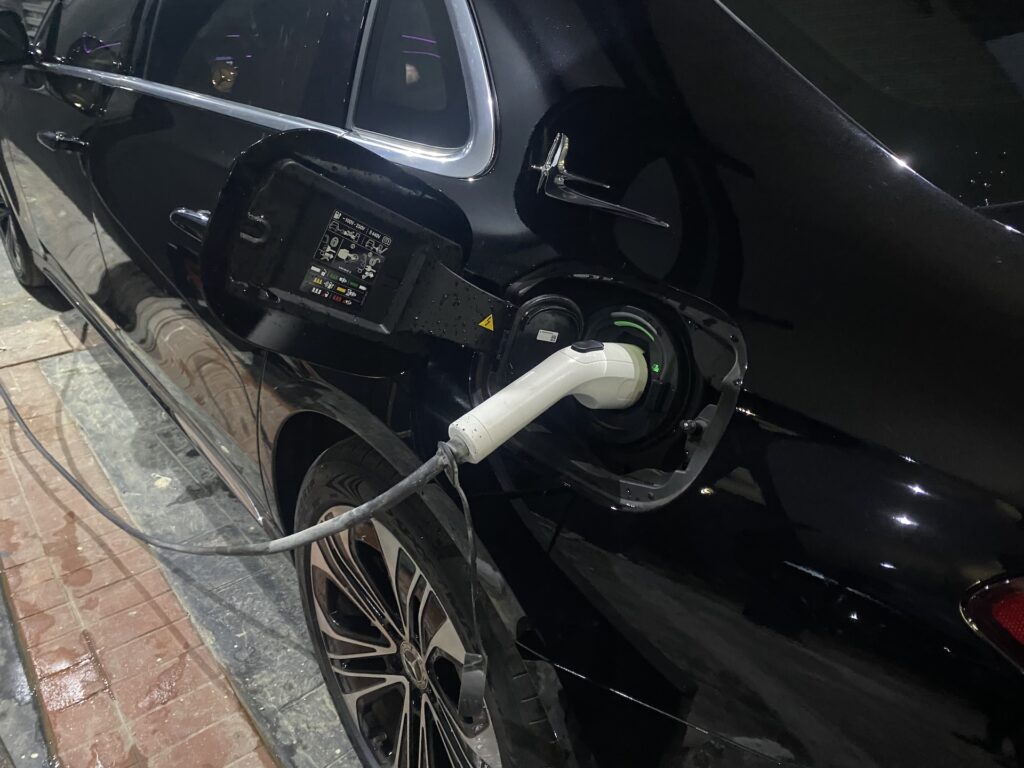
CCS2 (Combined Charging System) is a Type 2 connector with two extra large DC pins underneath. It is why the charging port on most modern EVs looks like a circle with a bulge below it: the top half takes your Type 2 AC cable at home, and the whole thing takes a CCS2 gun at a DC fast charger. One port, two standards.
CHAdeMO and GB/T: where imports complicate things
CHAdeMO is the older Japanese DC standard, found on some imported models. GB/T is the Chinese standard, and it appears on vehicles imported directly from China, and both its AC and DC connectors are physically different from Type 2 and CCS2.
This matters in Nigeria more than in most markets, because a significant share of EVs here arrive as imports rather than through local dealers. If your car has a GB/T or CHAdeMO port, tell your installer before any hardware is ordered. Adapters exist for some combinations and not for others, and a charger you cannot plug into is an expensive ornament.
How to check what your car takes
- Open the charging flap and photograph the port. The pin pattern tells an installer everything.
- Find the maximum AC charging rate in the owner’s manual. This caps what a wallbox can deliver.
- Check the DC maximum separately. It is a different number and applies only to fast charging.
- Note whether the car came with a cable, and which connector is on each end.
What this means for your installation
Once you know your connector and your car’s AC limit, specifying the charge point is straightforward: match the connector, do not pay for AC capacity the car cannot use, and size the circuit to the charger. Everything after that is an electrical question about your supply rather than a question about the car, which is where choosing the right EV installers matters most.
If you are still deciding where the charging will happen, our guide to EV charging station options in Abuja covers home, estate, workplace and public charging side by side, and our services page sets out what we install for each.
Not sure which charge point suits your vehicle? Call (+234) 706 727 6002, message us on WhatsApp, or book a free site assessment.